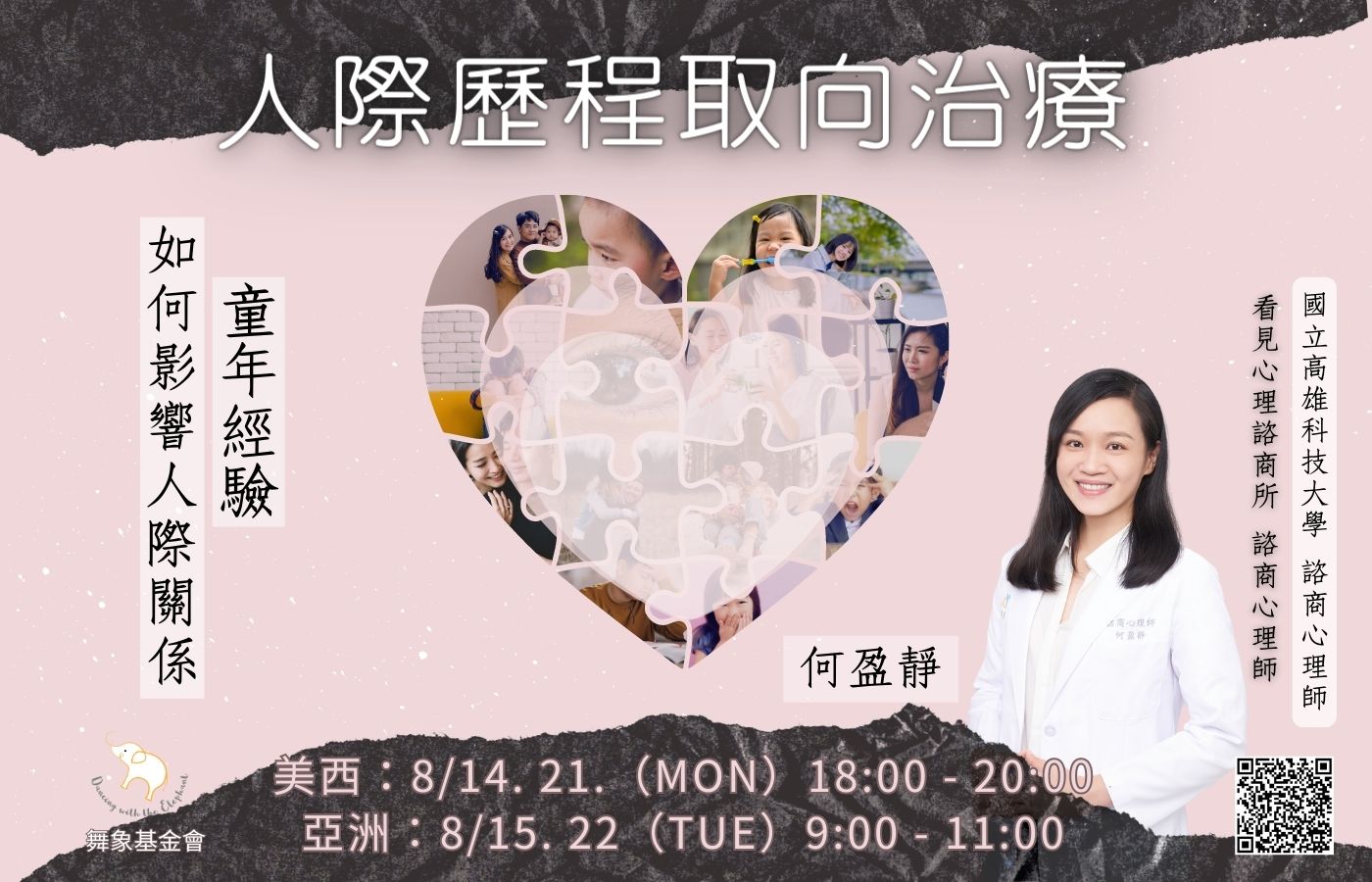
「一種米養百種人」每個人都這麼不同,如此獨一無二,這些種種行為個性、人際相處慣性模式,到底是如何被塑造出來的呢?我們可以重塑這個過程嗎?
家庭是一個人最初成長的環境,父母的教養型態往往影響了我們的心理狀態和處事應對態度。你認識自己和伴侶的依附型態和帶來的影響嗎?
在人際互動過程中,當我們感覺不安時,你又是採取什麼人際因應策略呢?
「看見心理諮商所」的何盈靜治療師以專業的心理諮商資格與經歷,長期在各學校院所、樂齡中心深耕,幫助人們在追求人生的目標外,同時保持身心的平衡及人際間的心理健康。
老師將藉由測量成人依附型態,透過模擬案例討論如何改善僵化的人際因應策略,進而運用人際歷程取向治療的概念修復創傷,找出個人調整人際互動方式的最佳方案。
就是此刻,邀請您為自己的人生停下腳步,重新審視童年經驗如何形塑著長大的自己,影響人際關係的進退,與自己和解,也學習更有彈性、更加自在的互動關係!
【課程大綱】
(一)
家庭是形塑一個人成長的環境,透過了解一個人受到依附型態與父母教養型態的影響,可以促進心理狀態的調整。
成人依附研究依循「焦慮」與「迴避」兩個軸線面向來測量成人依附型態,可分為:安全依附型(低迴避/低焦慮)、排除依附型(高迴避/低焦慮)、焦慮依附型(低迴避/高焦慮)、害怕依附型(高迴避/高焦慮)。而父母教養型態可分為:專制型教養、縱容型教養、疏離型教養、威信型教養。
講師將透過模擬案例介紹童年或家庭中可能受創的來源,以及運用人際歷程取向治療的概念修復創傷。
(二)
家庭可以是避風港,也可能是人際關係會產生問題的根源,在人際互動過程中,當我們感覺不安全或者需求未被滿足時,可能會出現適應不良的自我內在狀態與人際因應策略,以至於產生人際困擾。適應不良的自我內在狀態包含有:運用照顧者的方式對待自己、運用照顧者對待自己的方式對待他人、引發他人與照顧者同樣的方式對待自己,而缺乏彈性的人際因應策略包含有:順服取悅、對抗攻擊、遠離迴避。
講師將藉由模擬案例介紹人如何學習到僵化的反應方式,並且在人際互動中重複出現,進而運用人際歷程取向治療的概念調整人際互動方式。

【學習目標】
(一)
1、認識成人依附型態及教養型態,了解安全依附及威信型教養的特性。
2、學習運用知識發展自我的親密與自主策略,重建安全感及自我價值。
(二)
1、認識適應不良的自我內在狀態及僵化的人際因應策略。
2、辨識他人及自我的人際溝通模式,學習更有彈性的互動策略。
【老師簡介】
何盈靜
學歷:
– 台北市立大學心理與諮商學系碩士班諮商組/碩士
現職
– 看見心理諮商所 諮商心理師/實習心理師諮商督導
– 國立高雄科技大學 諮商心理師
專業資格
– 中華民國諮商心理師
– 長照服務人員證明-醫事人員

【Interpersonal Process in Therapy】 – How Childhood Experiences Affect Interpersonal Relationship
Lecturer: HE, Ying-Jing
Family provides the environment that shapes the development and growth of a person. Exploring how a person is affected by attachment and parenting styles, one can promote self-understanding and make sense of emotional and psychological trauma.
The study of adult attachment styles follows two axes, “anxiety” and “avoidance”, to measure attachment styles among adults. The two axes can be divided into: secure attachment (low avoidance/low anxiety), dismissive (high avoidance/low anxiety), anxious/insecure (low avoidance/high anxiety), fearful avoidant/disorganized (high avoidance/high anxiety). Also, parenting styles can be divided into authoritarian parenting, permissive parenting, neglecting/uninvolved parenting and authoritative parenting.
The lecturer will use simulated case studies to introduce the possible sources of childhood or family trauma and will apply the concept of interpersonal process psychotherapy to heal trauma.
The family can be a haven, or it can be a source of problems in interpersonal relationships. In the process of interpersonal interactions, when we feel insecure or our needs are not met, maladaptive inner coping strategies and interpersonal styles may appear to create distress. Maladaptive inner conditions include using a caregiver’s parenting and caregiving style to treat oneself and others, causing others to respond in the same manner. Inflexible interpersonal coping strategies include fawn, fight, or flight.
The lecturer will use simulated case studies to introduce how a person learns the freeze response and shows how this coping strategy appears repeatedly in interpersonal interactions. The lecturer will then apply the concept of interpersonal process psychotherapy to adjust and regulate the interpersonal coping styles.
【Learning Goals】
(I)
a. To learn adult attachment and parenting styles. To understand secure attachment and authoritative parenting
b. Learn how to apply self-knowledge and take initiative to rebuild a sense of security and one’s self-esteem.
(II)
1. To learn maladaptive inner conditions and the freeze response as interpersonal coping strategy
2. Differentiate the interpersonal communication or coping styles of self and others. Learn to cope with more flexibility.
【Teacher profile】
He,Ying-jing
Education:
– University of Taipei, Department of Psychology and Counseling, Master of Science in Psychology and Counseling
Current Positions:
– Seeing Counseling Center Counseling psychologist/Counselor
– National Kaohsiung University of Science and Technology Counseling Psychologist
Professional qualifications
– Counseling psychologist of Taiwan
– Certificate of Long-Term Care Service personnel-medical personnel
線上直播注意事項
(線上直播注意事項不適用於【實體活動、實體工作坊】,實體活動、工作坊請依各活動之專屬規範為準。)
一、舞象官網說明
為服務世界各地學員,舞象已成立兩個官網,提供學員擇一使用,一人一帳號須遵守舞象規範。
1.國際官網–官網名稱:舞象基金會
主要服務北美、歐洲、南美、台灣、馬來西亞、新加坡、印尼、日本等海外地區;國際官網系統設定時間以美西時間為主,報名時請留意個人所在地的時區,避免錯過課程。
2.大陸官網–舞象文化
主要服務大陸內地;大陸官網系統設定時間以亞洲時間為主,報名時請留意個人所在地的時區,避免錯過課程。
二、線上直播課程報名相關規定
1.報名時勾選提交【同意書】,表示已充分閱讀、理解,並同意遵守所有規範與相關規定。
2.兩個官網的付費課程將在有效期內提供影片回放觀看,或未來做成錄影回放於舞象官網販售,舞象保有活動、課程影片版權所有權。
3.錄影回放販售影片內容,可能包含課程中學員的個人分享及講師與學員對話;報名舞象課程請務必知悉,舞象保有活動、課程影片處理權及版權所有權。
4.舞象新增影音系列、音頻系列相關規範,請參閱課程說明,舞象保有影音、音頻版權所有權。
5.報名繳費後課程尚未開課前,因個人原因無法參與課程者,請依舞象規定申請辦理取消;課程開課後將不提供取消退費服務;其他費用規範請參閱官網常見問題說明。。
6.舞象保留取消或變更開課時間的權利。若課程因故取消,舞象將全額退還已繳納費用。請在繳費前仔細閱讀並理解相關條款,繳費行為即表示已閱讀並充分接受相關條款。
7.請閱讀【線上課程注意事項】或【實體/線下活動規則】繳費即表示本人同意並遵守相關規定。
8.最終解釋權歸舞象基金會「Dancing with the Elephant」所有,舞象保留隨時修正、補充說明、暫停或取消辦法之權利。
三、線上直播會議室 ZOOM ID查詢
線上會議室 ID訂於開課前三天在官網課程頁面公布,請自行登入報名課程查詢
舞象基金會官網:https://www.dancing-with-the-elephant.com/my-account/?login
會議室ID查詢四步驟:
👉🏻登入會員專區→ 我的課程→ 查看課程 (會議室ID課前三天公布,若公布時間未到請耐心等候)
四、付費影片回放、講義查詢
- 免費課程-無提供影片回放、講義。
- 付費課程-提供有效限期內可無限次回看、查詢。
- 建議優先使用電腦設備看影片回放,平板、手機可能會影響影片播放順暢,請留意。
- 影片上傳官網需等待48小時(不含節假日),請耐心等待。
五、影片回放有效期限
- 付費課程回放三十天,課程結束當日起算,若有特殊課程則需配合講師之指定時間截止。
- 亞洲區學員回放時間截止需注意,每年兩次冬/夏令時間略有不同,請留意。
- 舞象保留制度更改權力,詳情請參閱官網課程說明。
六、其他資訊
- 舞象主辦單位保有報名者參與資格之權益。
- 其他未盡事宜請參閱官網常見問題
- 客服信箱: [email protected]
- 線上客服:Messenger




 03/06 17:30